
November 4, 2026
Facts and Myths About Full Mouth Reconstruction
Implant Dentistry


November 4, 2026
Implant Dentistry

Quick answer: Full mouth reconstruction is a plan to restore all or most of your teeth so you can chew, speak and smile comfortably again. It does not always mean removing every tooth, it is not only cosmetic, and age alone rarely rules you out. Implant-supported results are durable, but they still need regular maintenance.
“Just pull them all.”
That was the first thing she said when she sat down. Years of broken fillings, a few lost teeth, a partial denture she hated, and she was tired of fixing one problem at a time.
She had heard about full mouth reconstruction from a friend. She had also heard it was only for movie stars, that it hurt for months, and that she was probably too old for it anyway.
Most of what she had heard was wrong. Some of it was half right.
The simple answer is… full mouth reconstruction rebuilds the health, function and appearance of your whole mouth, rather than treating one tooth at a time.
The more honest answer is… it is a big commitment of time, money and care, and the right plan looks very different from one person to the next. Separating the facts from the myths is the best place to start.
It is a term for restoring all or nearly all of the teeth in one or both jaws. It can include a mix of treatments:
Our restorative dentistry services and full mouth dental prosthesis options show how many different paths there are.
People who consider it usually have several problems at once: many missing teeth, teeth worn down by grinding or acid, repeated broken fillings and crowns, advanced gum disease, or a denture that no longer fits. The common thread is that fixing one tooth at a time is no longer working.
Fact: Not necessarily.
For some people, keeping healthy teeth and restoring them with crowns or fillings is the best plan. For others, the remaining teeth are failing and replacing a whole arch makes more sense.
The decision depends on how much healthy tooth, root and bone is left, and how predictable each tooth would be if saved.
Keeping a tooth that can last is almost always worth discussing.
Fact: Full mouth reconstruction is mostly about function.
The goal is to let you chew comfortably, bite evenly, speak clearly and stop dealing with pain or broken teeth. A better-looking smile is usually part of the result, but it is not the main reason for the treatment.
If your teeth are healthy and you mainly want to change their color or shape, a smile makeover may be a better fit. Our article on the steps to a successful smile makeover explains how that kind of plan works.
Fact: Age alone is rarely the deciding factor.
In a meta-analysis of implants in adults 65 and older, 96.2% of implants survived at 5 years and 91.2% at 10 years. The authors concluded that age alone should not be a limiting factor for implant treatment (Srinivasan et al., 2017).
Overall health, medications and healing ability matter more. Our page on dental treatments for seniors covers options many older adults consider.
Fact: Some people can leave with fixed teeth on the day of surgery. That does not mean treatment is finished.
A systematic review of full-arch implant treatment found that, when cases are selected carefully, attaching teeth right away gave similar implant and prosthesis survival to waiting. The authors noted that most studies required the implants to be very stable when placed, and urged caution because of many confounding factors (Papaspyridakos et al., 2014).
In practice, the implants still need months to fully bond with the bone. Our full mouth dental implants page notes that treatment typically takes 4 to 6 months from start to finish, and not every patient qualifies for same-day teeth.
Fact: Implant-supported teeth are durable, but they are not maintenance-free.
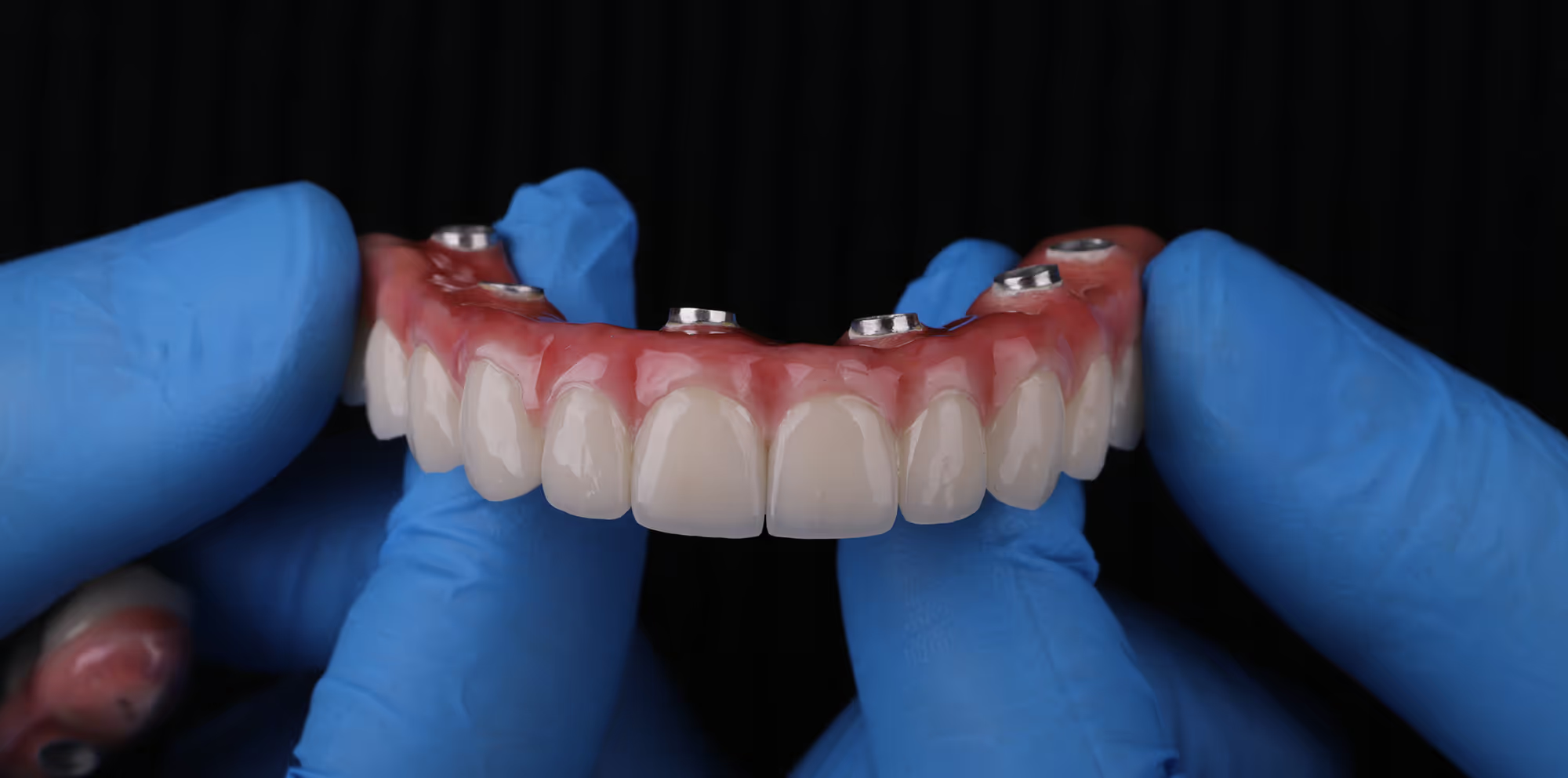
A study of patients with fixed full-arch implant teeth followed for up to 12 years found that 98.7% of the implants survived. Over that same period, peri-implantitis, an infection around the implant, affected 10.1% of implants, and heavy plaque was linked with more bone loss (Papaspyridakos et al., 2018).
The prostheses themselves also need care. In the same group of patients, 91.6% of the full-arch prostheses were still in use after an average of 5.2 years. Wear of the prosthetic material was the most common issue, and resin teeth wore faster than porcelain (Papaspyridakos et al., 2020).
Plan on regular cleanings, checkups and occasional repairs.
Fact: Dentures are a real and useful option, but they work differently.
Traditional full and partial dentures rest on the gums. They do not replace tooth roots. Implant-supported teeth are anchored in the jaw.
In a meta-analysis of randomized trials comparing lower dentures held by implants with conventional dentures, people with implant-retained dentures were more satisfied at a clinically meaningful level (Emami et al., 2009).
Here is how the main full-arch choices compare:
OptionHow it stays inRemovable?Surgery?Typical range at our officeConventional dentureRests on the gumsYesNoLowest upfront costImplant-supported overdentureSnaps onto implantsYes, by youYesVaries with number of implantsAll-on-X fixed arch4 to 6 implants per archNo, only by your dentistYes$20,000 to $35,000 per archFull mouth dental implantsMultiple implants throughout the jawNo, only by your dentistYes$20,000 to $50,000+ per archReconstruction with your own teethCrowns, bridges and fillings on natural teethNoSometimesDepends on the teeth treated
Our All-on-X implants page explains how angled implants can support a full arch with fewer implants.
Fact: Bone loss changes the plan. It does not always close the door.
After teeth are removed, the jawbone shrinks. Human studies found the ridge lost 29% to 63% of its width and 11% to 22% of its height within about six months (Tan et al., 2012). Years of wearing dentures can add to that loss.
Grafting, angled implants and other approaches can sometimes work around it. Our article on what to do if you are told you are not a candidate for implants explains these options in more detail.
The sooner bone loss is addressed, the more options you usually have.
Fact: Recovery takes time, but it is usually not months of pain.
Most discomfort after extractions or implant surgery is strongest in the first few days and then eases. Swelling and soreness are common and expected. Soft foods are part of the plan while the implants heal.
The longer part of recovery is not pain. It is waiting for the bone to heal and for your mouth to adjust to new teeth.
For anxious patients or longer appointments, sedation options such as nitrous oxide, oral sedation and IV sedation can make the surgical visits much easier to get through.
Ask what the first week will look like for your specific plan, so you can arrange time off and meals ahead of time.
There is no single number, because so much depends on what was done. Crowns on natural teeth, implant-supported bridges and dentures all age differently.
For implant-supported bridges, a systematic review found that 93.1% of supporting implants survived 10 years. Survival of the bridges themselves was 80.1% at 10 years across all designs, and was higher for metal-ceramic bridges than for older gold-acrylic designs (Pjetursson et al., 2012).
Long-term reviews of implants in general show roughly 95% survival over 10 to 25 years (Moraschini et al., 2026). Our full mouth prosthesis page notes that implant-supported teeth can last many years or even decades with proper care.
What shortens that timeline most? Plaque around the implants, smoking, grinding without a night guard and skipped checkups.
This is the distinction that clears up most confusion.
Reconstruction means rebuilding your mouth with whatever combination of treatments makes sense. Some of your own teeth may stay.
Replacement means removing the remaining teeth in an arch and replacing them all with implant-supported or removable teeth.
Both can be called full mouth reconstruction. The right one depends on what you have to work with, what you want and what will hold up over time.

For patients in Clifton and the surrounding area, a full mouth evaluation at our office usually includes:
From there, we can lay out realistic options side by side, including the trade-offs of each.
Costs vary widely because the treatment itself varies so much. Ranges published on our service pages include:
Removable options cost less than implant-supported ones. Your estimate will depend on how many teeth are saved, whether grafting is needed and the type of final teeth you choose.
Insurance coverage varies, and some plans cover portions of treatment. We verify your benefits and offer financing through Cherry. If you still have general implant questions, our dental implants FAQ answers the most common ones.
Tired of fixing one tooth at a time? Contact Marvel Dental in Clifton, NJ to schedule a full mouth evaluation and see every option laid out in one plan.
Experience dental care that puts your comfort, confidence, and health first. We're here to make dental visits feel like your home away from home.
The team at Marvel Dental is ready to assist with your questions, coordinate your appointment, and guide you through a comfortable, well-organized visit from start to finish.